Retro and vintage chandeliers: how to choose the right one
Added 27.8.2026 13:06.49
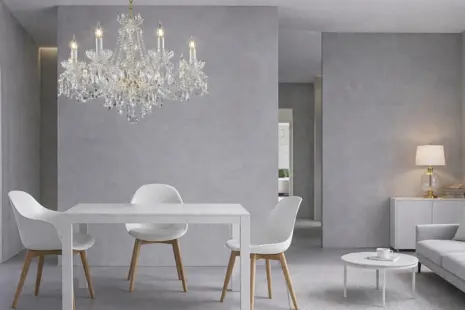
A retro chandelier and a vintage chandelier look almost identical in a photograph. The difference is in what the photo does not show. A vintage piece is a genuine old original — you buy its original wiring along with it, and spare parts you can only find at auction or second-hand. A retro chandelier is a new light in a period style: it meets current standards, carries a five-year warranty and spare parts stay available for ten years.
What is the difference between a vintage and a retro chandelier?
Vintage means a genuine old original with authentic patina and a history of its own. That age can also bring demanding maintenance, outdated wiring and very limited spare-part availability. A retro chandelier is a new light that borrows its look from a particular era while giving you the safety, warranty and service of a current product.
At first glance the two are almost impossible to tell apart. The difference shows in the purchase price, in how much upkeep the piece needs, and at the moment you have to replace a crystal drop or another component.
In catalogues, retro and vintage are used more loosely anyway — they describe the look rather than the actual age. That is also the case in the vintage lighting category at ArtCrystal. You will not find antiques there, but new lights inspired by historical originals.
.jpg "Chandelier, floor lamp and table lamp from one collection — vintage looks, current build.")
Brass is the material retro and vintage chandeliers share most often — its warm golden shine runs through every period decade and works in a modern interior as a contrast to pale surfaces. Brass lighting by ArtCrystal is made new in the Czech Republic: Art Nouveau light AL207, Floor lamp AS208, Table lamp AS210.
For more on the history, making and use of brass lighting in interiors, see the article Brass lighting for your stylish interior.
Why a second-hand original rarely pays off
A glass chandelier from the 1950s looks irresistible in a photo. The problem is that its parts age at very different rates.
Metal and glass last centuries. Wiring does not. Textile insulation from the 1960s grows brittle and cracks over the decades — often exactly where the cable bends at the terminal block and where nobody can see it. Lamp holders corrode and lose contact.
This is a safety question, not a cosmetic one. With a sixty-year-old fitting you should budget for a complete rewire including an electrical inspection. The price in the listing is almost never the price you end up paying.
That is why most people who want the timeless design of past decades end up choosing a new light in vintage style. They get the shape and the mood — but with LED sources, dimming, and no inspection report to chase.
You can also pick matching pieces in the same design and coordinate the interior down to the last detail. ArtCrystal offers complete collections, from ceiling and wall lights to table lamps – so one style carries easily from the living room to the bedroom and the hallway.
.jpg "ArtCrystal Art Nouveau collection — designer chandelier L-TUL 03 and lights from the same line.")
The Art Nouveau collection by ArtCrystal is a good example. Arms cast in sand moulds echo flower stems, and the hand-cut crystal shades echo bellflowers. Every metal part is made by hand, so no two pieces are exactly alike — the designer chandelier L-TUL 03 shows it best. Other products from the collection are listed in the shop below the product description.
Why do old styles keep coming back?
British fashion historian James Laver described a scale back in 1937 that is still known as Laver's Law. It shows how the same object changes meaning simply by getting older:
-
-
- Right now — smart
- 10 years on — dowdy
- 20 years on — ridiculous
- 30 years on — amusing
- 50 years on — quaint
- 70 years on — charming
- 100 years on — romantic
-
Opal glass globes on brass are the textbook case. In the late 1950s they looked timelessly modern. Then fashion stopped seeing them for a few years — exactly as Laver's scale predicts.
And today? The shape is back among the icons and still in production. Same silhouette, but with LED sources and a build that will outlast another generation.
.jpg "Opal glass globes on brass — the late-1950s silhouette, built today.")
At ArtCrystal the shape lives on in Ceiling light TX907000004 and Ceiling light TX907000013. For rooms with higher ceilings there is the large ceiling light TX907000017, and to tie in a hallway or bedroom, the wall light TX907100002.
Which styles return most often in lighting
-
-
- Art Deco (1920s–30s): stepped shapes, opal glass, chrome and brass
- Mid-century and sputnik (1950s–60s): radiating frames, opal globes, slender rods
- Industrial (revival since the 1990s): enamelled shades, bare metal, exposed cable
- The 1970s: brass, smoked and amber glass, cascading drops
- 1980s postmodernism: coloured glass, playfulness — the newest wave of return
-
How to tell good glass and good metal
The word „crystal“ on its own says nothing about the quality of the glass. Under European Directive 69/493/EEC two figures decide it: oxide content and refractive index. Three categories are enough to get your bearings:
High lead crystal: oxide content PbO ≥ 30 %, refractive index ≥ 1.545
Lead crystal: oxide content PbO ≥ 24 %, refractive index ≥ 1.545
Crystallin: oxide content ZnO, BaO, PbO or K₂O ≥ 10 %, refractive index ≥ 1.520
The refractive index describes how strongly the glass bends light. The gap between 1.520 and 1.545 looks tiny on paper, but the difference in the room is clearly visible. A higher refractive index combined with a precise cut gives the glass more brilliance and scatters rainbow reflections across the space.
.jpg "Close-up of hand-cut drops — every facet sends the light a different way.")
The refraction shows best against brass, where the warm metal underlays the rainbow reflections. That same combination appears in Table lamp S332CE, Brass chandelier with drops L329CLN and Brass chandelier LA098CLN.
Four tests you can run in the showroom:
- Weight. Take a drop carefully in your hand. Crystal is heavier than you expect.
- Sound. Flick it with a fingernail. Crystal sings and rings on; ordinary glass gives a short click.
- The cut. A hand cut has a sharp, re-polished edge. Pressed glass has blunt edges and a visible mould seam.
- Clarity. Hold it against the window and look for bubbles and haze. A slight irregularity of shape is a mark of mouth-blowing, not a defect.
With metal, weight and surface decide. A cast part weighs noticeably more than thin sheet — lift an arm and you will feel it at once. And ask whether the brass is lacquered or left raw. Lacquered brass only needs wiping; raw brass darkens and develops a patina.
You can run all four tests yourself at the ArtCrystal showroom in Jablonec nad Nisou, the historic centre of Czech glassmaking — over 250 chandeliers on 590 m², where the team will show you the difference between crystal and ordinary glass, and between a cast and a pressed part, on the fittings themselves. Open Mon–Fri 8:00–16:00.
Where Czech chandeliers came from
The word lustre reached Czech through the French lustre from the Latin lustrare — „to illuminate“. Originally it did not mean „a light with drops“ at all, but something that brings light and shine.
The decisive year was 1683. Glassmaster Michael Müller of Michlova Huť near Vimperk developed a glass he called chalk glass, known today as Bohemian crystal. It was harder than Venetian cristallo and therefore allowed deep cutting. That combination of fine glass and precise cutting is what later made Czech chandeliers famous worldwide.
Chandelier-making became a trade of its own in 1724, when Josef Palme founded the first workshop near Kamenický Šenov. The firm Elias Palme later built on that tradition; its chandeliers hung in La Scala in Milan and the Waldorf Astoria in New York.
.jpg "Crystal light with drops — vintage looks, current build.")
The crystal ceiling light TX303000005 and the table lamp S236CE in gold. The cut drops tie the two models into one whole, so the main and supplementary lighting match without effort.
Where to hang a chandelier and which type to choose
-
-
- Let it play the lead. A period-style chandelier works best as the single strong ornament in an otherwise restrained room.
- Repeat the metal. Echo the metal colour two or three more times in the room – on handles, a table base or a mirror frame.
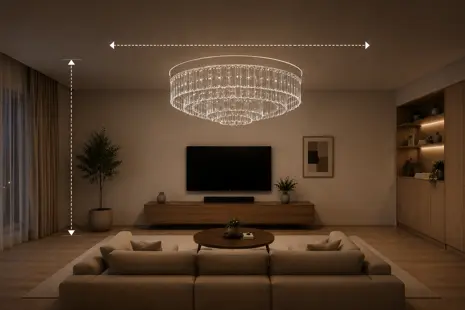
- Mind the height. Above a dining table, hang the chandelier 75–85 cm above the tabletop. In walkways, leave at least 213 cm of clear space beneath it.
- Get the scale right. The diameter should be roughly half to two thirds of the width of the table.
- Choose warm light. For living spaces 2,700 K is ideal. It recalls classic incandescent light and naturally underlines the character of period-style fittings.
- Watch colour rendering. With coloured and cut glass, choose lamps with a CRI (Ra) of at least 90. Only then do the tones, refraction and sparkle come through fully.
- Do not overlook the bulb. With clear glass the light source stays visible, so choose it as carefully as the fitting itself. LED candle bulbs with a decorative filament are ideal
- A retro table lamp as a trial run. Before you hang a chandelier, test the style on a small scale. A retro lamp on the bedside table costs a fraction, and within a week you know whether that colour and that metal suit you.
-
In short
Vintage and retro are used in two different contexts. In the auction world they help establish the age and provenance of an object; in lighting catalogues they describe style. ArtCrystal lights are new — and for good reason. Metal and glass can last centuries, but wiring from the 1950s rarely meets today's safety requirements.
So the choice comes down mainly to material quality. Three figures from Directive 69/493/EEC and four practical marks of good crystal — weight, sound, sharpness of the cut and clarity of the glass — are enough to judge it. For a detailed guide, see What crystal is and how to tell its quality and authenticity.
After that, only the style question remains — bolder retro or quieter vintage. A good chandelier is never merely a quotation of the past. It becomes the centre of the room — the one thing allowed to ask for attention.