Industrial chandelier: the contrast of steel and cut glass
Added 12.8.2026 9:04.55
Steel and crystal. Raw and radiant. Two materials that shouldn't work together – and yet, in an industrial interior, nothing works better. That tension is exactly what the industrial crystal chandelier is built on: a light that brings brilliance, broken across cut edges, into a raw world of concrete and brick. There are two routes to that contrast. The classic one places a traditional crystal chandelier in the middle of a bare loft as a decorative counterpoint. The second goes further and unites both worlds within the fitting itself – steel, brass or aluminium paired with cut glass and crystal. We'll look at both, and finish with specific lights in which metal and crystal meet in a single piece.
What is industrial interior style?
Industrial style wasn't dreamed up by designers – it came out of working factories. High ceilings, large windows and exposed structures were never an aesthetic choice; they were a necessity.
The turning point came in 1960s SoHo in New York, where struggling artists moved in after manufacturing left Manhattan – among them the sculptor Donald Judd, who bought a former textile factory on Spring Street in 1968 and deliberately left its raw structure on show (the building is a museum today).
.jpg)
Modern LE-PEN-DI light for industrial interiors combines glass and metal elements in a range of finishes and decors
Living there was illegal for years; only the 1982 Loft Law legalised it retroactively for the artists. From there the aesthetic crossed the Atlantic, and for the past two decades it has been among the most popular interior styles anywhere.
For those artists it was purely about function – light came from a bare bulb on a cable. The chandeliers we're about to show you go a step further. They take the essence of industrial design, meaning metal, geometry and a raw line, and develop it with cut glass and crystal into outright luxury.
Concrete, metal and raw materials
An industrial interior is built on concrete and metal, with wood, brick and leather alongside. The palette rests on black, brown, white and grey, lifted here and there by brick red or orange. A good light grows out of those same materials – and metal, whether steel, brass or aluminium, is what gives a chandelier its industrial character and ties it to the rest of the room. The question is how to add cut glass or crystal without the interior losing its rawness.
The crystal chandelier as a contrasting element
A traditional crystal chandelier with richly decorated arms and cut trimmings acts as a deliberate counterpoint among raw brick, concrete and steel – delicate, glossy and opulent. It works because industrial style has always been about assembling mismatched things into one coherent whole. A classic chandelier above a dining table, or in a living room with exposed pipework, creates a striking visual break that lends the space a touch of luxury.
.jpg)
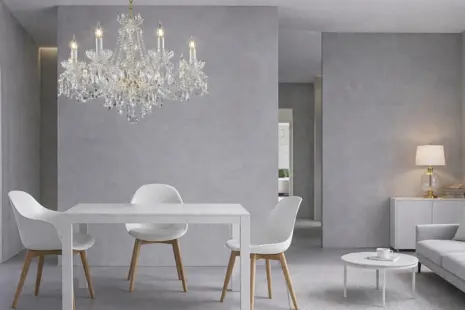
Modern crystal chandelier EL1021402 OVALPB with fourteen bulbs and trimmings of genuine Czech cut crystal makes a striking companion to a large dining table in an industrial setting.
The counterpoint: an industrial chandelier where steel meets cut glass
But contrast isn't the only route. The second and increasingly popular option is lights that carry their industrial character in the construction itself – steel, brass or chrome merging with cut glass or crystal in a single piece. Instead of traditional decorated arms you'll find prisms, geometric shapes, laser-cut metal or sandblasted glass, lit by the sparkle of cut trimmings.
.jpg)
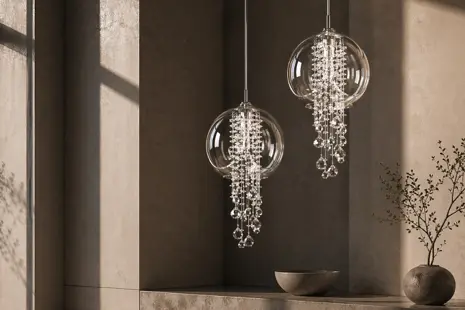
A textbook example is the L-SWI-03 light: three sculpted elements of laser-cut brass filigree, with sparkling crystal trimmings suspended on cables at the centre.
The advantage is obvious. A light like this doesn't have to overpower the room with contrast, because the material logic of the interior is written into the fitting itself. Metal echoes the pipes, beams and exposed structures around it, while cut glass and crystal add a play of light and a subtle luxury that keeps industrial style from tipping into cold austerity. Lights like these suit lofts, but equally modern apartments, offices, restaurants or showrooms where the space needs to look designed.
.jpg)
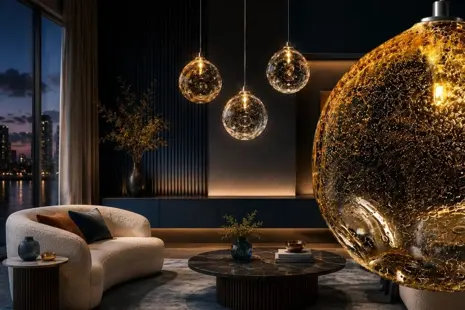
Three metal and crystal pendant lights LE-CHE-A in a gold finish above a kitchen island in an industrial-style kitchen.
Which room does it suit?
Practically any. Both classic crystal and industrial-leaning models work in the living room, the dining room and the bedroom, and thanks to their clean, functional lines they aren't limited to industrial interiors – they look just as good in a modern minimalist space or a Scandinavian one.
.jpg)
LE-TRI-4XT03001 – a lighting composition of four separate fittings with triangular bases that can be rearranged on the ceiling however you like: in a line, a square or a free scatter.
Scale matters more than what the room is used for. For large open-plan living and dining spaces we recommend bolder compositions such as LE-TRI-4XT03001 or LV094; for smaller rooms and bedrooms, more restrained lights such as L-TAL-02 or LE-PEN-RA. The final word always belongs to your taste and the dimensions of the space.
.jpg)
A unique pendant light, L-MAN-08, made of laser-cut and polished triangular metal and glass elements is well suited to modern and industrial interiors with high ceilings.
Frequently asked questions
- How do I choose an industrial chandelier for my home?
Either as a contrasting element, in the form of a classic decorated crystal chandelier, or as an industrial chandelier that brings metal and cut glass together in its own construction.
- Which industrial chandelier should I choose for a kitchen or dining room?
A pendant light above the table with adjustable cable height works well in a dining room – for example LE-CHE-A or LE-TRI-VKA.
- Can I mix several types of chandelier in one home?
Yes, as long as the materials and colours – metal, glass, light temperature – correspond from room to room.
We're here for you
Need help choosing? Get in touch – we'll be glad to help you tune your interior to the tones that suit you. Industrial ones, perhaps, where steel meets cut glass.