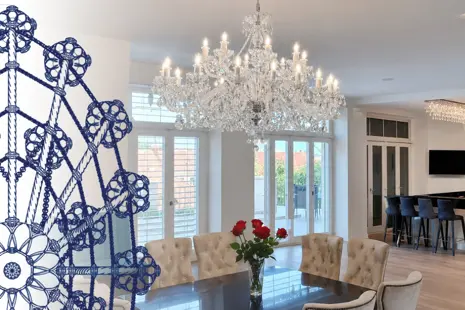
How high to hang a chandelier: exact measurements for the living room, dining room and bedroom
Added 22.10.2026 15:27.58
A chandelier hung fifteen centimetres too low gets in the way. Hung fifteen centimetres too high, it loses its connection with the room and its light gathers uselessly beneath the ceiling. The right hanging height is not a matter of guesswork. It follows from a handful of proven measurements and rules. We have set them out room by room, so that you can determine the correct height for your chandelier before it is installed.
The basic rule: 210 centimetres of clear space
Wherever people walk beneath a chandelier, one simple rule applies: its lowest point should be at least 210 cm above the floor. Measure to the last drop or the bottom bowl, not to the body of the chandelier. Even a tall person can then pass underneath comfortably, and the chandelier will not read as an obstacle in the room.
With ceilings higher than 270 cm, it is worth hanging the chandelier a little higher. As a rule of thumb, every additional 30 cm of ceiling height raises the lower edge of the chandelier by roughly 7–8 cm. The fitting then keeps the right proportion to the height of the room and looks natural in the space.

How to translate ceiling height into chandelier size
Before you decide on the hanging height, check that the size of the chandelier suits the room. Hanging height and chandelier size are closely linked: in a room with a low ceiling, a tall chandelier simply has no room.
-
-
- Ceiling up to 250 cm – choose a flush-mount or semi-flush chandelier with an overall height of up to 40 cm. A chandelier on a chain will only fit here above a table that nobody walks under.
- Ceiling 250–280 cm – the most common height in flats and family houses. A chandelier 50–65 cm tall on a short drop keeps the lower edge above the 210 cm line.
- Ceiling 280–320 cm – typical of period apartment buildings. The room can carry a chandelier 70–90 cm tall with a visible chain or rod, which gives the composition a vertical line.
- Ceiling above 320 cm – entrance halls, staircases, ballrooms. The total height of the chandelier including its drop can take up a third of the room height or more.
-
For the diameter, a simple formula works well: add the length and width of the room in metres and take the result as the chandelier's diameter in centimetres. A room of 5 × 4 m therefore suits a chandelier about 90 cm across. We cover dimensions in more detail in our guide how to choose a chandelier and in the article choosing a crystal chandelier for your ceiling height.
Choosing by size directly in our online shop
So that you do not have to do the maths yourself, we make choosing by size easier in two ways:
-
-
- Size filter – in our chandelier range, you can narrow the selection to fittings whose dimensions suit your room.
- A recommendation for every fitting – on each product page you will find the overview “Is this chandelier right for your room?”. It gives the suitable room area, the minimum ceiling height broken down into chandelier height and drop length, and the types of room the fitting suits. A chandelier 44 cm tall with a 30 cm drop, for example, needs a ceiling of at least 2.5 m.
-
If you are still unsure, our sales advisers will be glad to help you choose, free of charge.
Living room
In the living room, the chandelier usually hangs in the middle of the room – exactly where people walk. The 210 cm limit therefore applies, and with higher ceilings 220–230 cm is better. If the chandelier hangs above a coffee table, which forms a natural barrier, it can go 10–15 cm lower, bringing the light closer to where people sit and talk.
When the chandelier is not in the centre of the room
Modern layouts often combine the living room with the kitchen and dining area. The chandelier then belongs not in the geometric centre, but above the focal point of a specific zone – the sofa or the table. If the ceiling outlet is elsewhere, an electrician can move it, or the cable can be swagged decoratively to a second ceiling hook. You will find fittings for this space in our living room chandeliers category, and the wider picture in our complete guide to choosing a living room chandelier.

Dining room: measure from the tabletop
Above a dining table, the rule changes. Nobody walks under the chandelier, so the height is measured not from the floor but from the tabletop. The lower edge of the chandelier should be 75–90 cm above the table. With a standard table height of 75 cm, that means 150–165 cm from the floor.
-
-
- 75 cm above the table – intimate, focused light, suited to lower ceilings and smaller tables.
- 80–85 cm above the table – a balanced height for most dining rooms with a ceiling of around 260 cm.
- 90 cm above the table – for high ceilings and large chandeliers, so that diners can see each other across the whole table.
-
Take the chandelier's size from the table: its diameter should be half to two thirds of the table's width, leaving at least 30 cm to each edge. Above a long rectangular table, two smaller chandeliers or one elongated fitting work better than a single large round one. You will find fittings for this space in our kitchen and dining room chandeliers category.
A new addition to our range takes this principle to its logical conclusion: an elongated crystal chandelier measuring 160 × 90 cm with 24 bulbs, which follows the outline of the table. From the side it has a wide, oval profile; from the end it is narrow. Light falls evenly along the full length of the table, and guests on opposite sides keep a clear view of each other. Originally created as a commission for a specific interior, it is now a permanent part of our range.

Bedroom: above the bed or in the centre
In the bedroom, it all depends on where the chandelier hangs. In the middle of the room, where people walk, the 210 cm rule applies again. Above the bed it can hang lower, but leave at least 130 cm between the mattress and the lowest point of the chandelier. With a standard bed height, that is around 180–190 cm from the floor. You can then sit up comfortably in bed and kneel on it when changing the bedding.
Pendant lights either side of the bed
Above the bed, smaller and flatter chandeliers are preferable, with a diameter no greater than half the width of the bed. A large chandelier with long drops feels heavy above a place of rest.
Pendant lights above the bedside tables work very well in the bedroom. They replace bedside lamps, free up the tabletop and keep the light where you read in the evening. Hang them so the lower edge is about 50–60 cm above the bedside table, so the light does not shine into your eyes yet still falls on your book. Our article pendant lights for the bedroom and modern chandeliers above the bed shows how this looks in real bedrooms, and you will find a selection of fittings in our bedroom chandeliers category.

Hallway, staircase and double-height spaces
In the entrance hall and corridor, people walk everywhere, so the 210 cm limit applies without exception. In a narrow corridor with two facing doors, also make sure that an open door leaf cannot catch the chandelier. Above a staircase, measure from the highest step beneath the chandelier, not from the ground-floor level.
In a hall with a gallery or double-height ceiling, the chandelier usually hangs so that its lower edge does not drop below the level of the ground-floor ceiling, and its body is clearly visible from both the gallery and the entrance. You will find fittings for these spaces in our hall and staircase chandeliers category.

How to check the height before installation
Before the installer shortens the chain or cable, try the height out first.
-
-
- Ask for a visualisation – send us a photo of the room with its dimensions, and we will place your chosen chandelier into it at its real size and hanging height. You will see how it looks before you order. We explain how on our page how to choose a chandelier.
- Measure the ceiling height – from floor to ceiling at the point of the outlet, not by the wall. In older buildings the ceiling height can vary by several centimetres.
- Add up the dimensions – the overall height of the chandelier (body and drops) plus the length of the drop. Subtract the result from the ceiling height, and you have the height of the lower edge above the floor.
- Mark the outline on the floor – use masking tape to mark a circle or rectangle the size of the chandelier on the floor. You will see how much of the room it takes up and how it relates to the table or sofa.
- Walk around it – around the marked outline, with the doors open and the chairs pulled out.
-
On most chandeliers in our range, the height can be adjusted via the length of the chain or rod. Before ordering, check what drop length the chandelier comes with and whether it can be changed.
Installing a chandelier: what to keep in mind
Connecting a chandelier to the mains must only be carried out by a suitably qualified electrician in accordance with the applicable regulations. Before installation, check the load-bearing capacity of the ceiling and the fixing: large crystal chandeliers can weigh several dozen kilograms, and a plasterboard ceiling will not hold them without reinforcement. For heavier pieces, it is worth consulting a structural engineer or fixing the chandelier to the load-bearing structure.
We offer installation with every order. Our installer assembles the chandelier, hangs the crystals, suspends it at the chosen height and connects it, so you can fine-tune the height on site before the chain is shortened. We describe how installation works on the page installing a crystal chandelier, and what needs to be prepared in advance is summarised in installation requirements. Chandeliers from our range come with a 5-year warranty, and we provide spare parts and servicing for 10 years.
Summary
-
-
- Walkways – lowest point at least 210 cm above the floor; with ceilings above 270 cm, 7–8 cm higher for every additional 30 cm.
- Dining table – 75–90 cm above the tabletop; chandelier diameter half to two thirds of the table's width.
- Bedroom – 210 cm from the floor in the centre of the room; above the bed, at least 130 cm above the mattress.
- Hallway and stairs – 210 cm without exception; above stairs, measured from the highest step.
- Before installation – measure the ceiling height, add up the dimensions of the chandelier and drop, and test the height in advance, or ask us to place your chosen chandelier into a photo of the room.
-
If you are not sure which size and height suit your interior, come and see us at our showroom in Jablonec nad Nisou. Across 590 m², we display more than 250 lighting fixtures, and you can judge the hanging height right there.